
Thomas Hardy

“Convergence of the Twain”
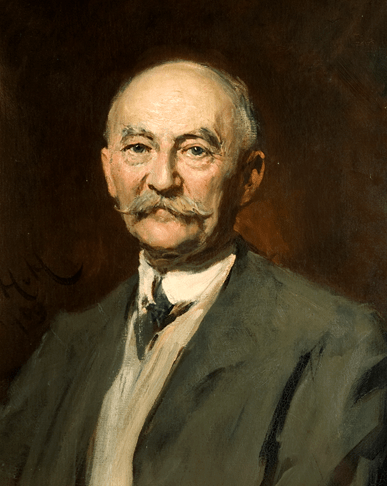
 

Thomas Hardy's poem "Convergence of the Twain" is an alternative perspective on the loss of the "Titanic" in April, 1912. The poem's major ideas concern the vessel, its state, and symbolic significance two years after the collision, and a speculation on how the iceberg came to converge with the ship. Hardy is very interested in affiliating the growth and fate of the iceberg and ship through the deification of nature and time. The first five stanzas of the poem concern the submerged ship itself, while the last six discuss its fate while afloat.

In the first five stanzas, Hardy's descriptions of the Titanic are consistently juxtaposed against the ship's present environment to emphasize the waste of money, technology, and craftsmanship. The furnaces of the ship, which contained "salamandrine fires" (5), now have "Cold currents thrid" (6) through them. Where there was once heat and life driving the engines of the ship, there is now coldness and death. A further juxtaposition within this second stanza is the use of the word "pyre" (4), as it connotes funerals and death, while the use of "salamandrine" insinuates a certain tenacity for life (as salamanders were said to live through fires) that could be associated with the Unsinkable Ship everyone believed the Titanic to be before accident.

Hardy further emphasizes the waste of the ship's magnificence by describing how useless the "opulent mirrors" are to uncomprehending sea-worms that are "grotesque, slimed, dumb, indifferent" (9). The jewels on board the ship, now at the ocean's floor, become "lightless, all their sparkles bleared and black and blind" (12). The poet's use of multiple adjectives and alliteration intensifies the somber nature of these descriptions. The items that Hardy has chosen in his poem to embody the loss of the ship (the cold furnaces, bleared mirrors, and lightless jewels, rather than the loss of life) are indicative of his attitude towards the ship and what it stood for.

The Titanic was not simply a ship built to traverse the ocean; it was a symbol of the wealth, power, and industrialization of Britain during this time. The items which appear in Hardy's poem are representative of the power, wealth and vanity of the British nation. Hardy's discussion of these items, rather than the more glaring issues of death and human suffering normally associated with the loss of the ship, would seem to indicate his disdain for the pride and importance that his contemporaries placed upon scientific and technological progress.

Hardy's discussion of the Titanic shifts in stanza six to address the cause of the disaster. His use of enjambment between the sixth and seventh stanzas seems to be a technique employed to represent not only the coming together of the iceberg and ship in the poem, but also their literal collision. Hardy's use of deification for both nature and time in the last six stanzas contribute to the ominous and fated quality of the Titanic disaster. Hardy suggests that the Titanic converging with the iceberg was not a coincidence, but rather an event planned by an "Immanent Will" (18) and "The Spinner of the Years" (31); inferring the ship had been destined for destruction since its inception. The eighth stanza, perhaps the most ominous of the poem, outlines how the ship and iceberg grew to their completion concurrently, "as the smart ship grew / In shadowy silent distance grew the Iceberg too" (22, 24). Hardy uses words such as "mate" (19), "intimate welding" (27), and "consummation" (33) to emphasize the apparent predestination that these two behemoths seemed to have, and to imply a wedding or sexual union of those mighty opposites.

Although he does not indicate implicitly that he believes in the powers he names, Hardy weaves these deifications into the poem to create a desired effect. The powers are not portrayed as benevolent or merciful as the Christian God would be, but rather they are the cause of this disaster. It would seem that Hardy is telling his audience that humanity, no matter how progressive we may become, will always be at the whim of nature, which has no feeling or care. We are not able to rise above or control a monolith such as the sea regardless of how far our progress has taken us. Knowing the Titanic disaster then, according to Hardy, should be a constant and humbling reminder of humanity's fallibility.


http://www.victorianweb.org/


“Ah, Are You Digging on My Grave”


“Ah, Are You Digging on My Grave,” is a poem written by Thomas Hardy. The central theme of this poem is death, which is also seen in several different forms throughout the works of Thomas Hardy. There is a great deal of disappointment expressed in this poem. The Oxford Reader’s Companion to Hardy deems it, “a satire of circumstance” (Page 378). Thus, death and the afterlife are things of tragedy in this particular work. The point that Hardy makes is that no love or hate outlasts death.

An important aspect to the poem’s structure is that it is written sequentially in order to prepare the reader for an unsettling ending. Hardy takes us on a downward spiral through, as The Pattern of Hardy’s Poetry puts it, a “series of steps from appearance to reality” (Hynes 53). The dead woman believes that someone she loved is there at her grave. This, however, she finds out is untrue through a devastating sequence of disappointments. The woman originally suspects that the person at her grave is her husband, but sadly it is not. In reality, her husband is off with his new love, and feels that since she is dead it, “cannot hurt her now” (p.48; l.5). Consequently, the woman guesses again, thinking this time it is her closest of kin. She is, yet again, disappointed. She finds out that they do not care to think of her anymore. This feeling of neglect is seen in the line, “What good will planting flowers produce?” (p.48; l.10). In other words, the family of the woman would rather not think of her than hurt themselves by doing so. Their reason for not going to see her is that nothing can bring her back from, “Death’s gin” (p.48; l.12). At this point, Hardy has still not revealed the digger’s identity. He continues to do this, according to A Critical Introduction to the Poems of Thomas Hardy, to show that, “the eager hopefulness of the dead woman is mercilessly quenched” (Johnson 138).

Next, we come upon a slightly different subject. In the third stanza, the woman sees now that not only has she been forgotten by her most beloved, but also by her worst enemy. She is told that her enemy, “cares not where you lie” (p.48; l.18). Similarly, as with her loved ones, her enemy simply thinks the woman no more worth her time to worry about.

In the next stanza, the woman has exhausted all of the possibilities, so she gives up and asks who is there. She now finds out that it is her dog. Hardy himself loved animals and it is not a surprise that he would use a dog as the digger. As seen in Victorian Poetry, Hardy, “always championed kindness to animals” (9: 465). He, however, creates a surprising twist, at the end of the poem. Earlier on, in the fifth stanza, the woman praises the noble dog, stating how no human can rival, “A dog’s fidelity” (p.49; l.12). In the last stanza of this rather depressing poem, comes the final blow to the woman. The dog has not remembered her either and has, in fact, mistakenly trodden upon her grave.

In the words of The Pattern of Hardy’s Poetry, the dog believes that her grave is, “a place to bury bones, not affections” (Hynes 53). So, even her faithful dog does not care to remember her.

“Ah, Are You Digging on My Grave,” is a very tragic and sad poem. It is written in Victorian Studies that, “Hardy recognized that personal relations provide no sure refuge from tragic experience” (36: 176). This plainly means that, as far as death is concerned, few are truly remembered, if any, after they are dead and gone. The most important parts of the woman’s life were, indeed, the people that she knew. From her husband and her kin, to her worst enemy and loyal animal friend, the woman finds out little by little that none of them care enough to come to her grave. The dog does, however, come to her grave but only by mistake. It seems as though the woman has not lived on in their memories, rather, everything that she was to them was sealed, like herself, in the grave.


http://studentbounty.com/

ادبیات قرن 17 و 18 - John Donne

John Donne

“The Flea”


Summary

The speaker tells his beloved to look at the flea before them and to note “how little” is that thing that she denies him. For the flea, he says, has sucked first his blood, then her blood, so that now, inside the flea, they are mingled; and that mingling cannot be called “sin, or shame, or loss of maidenhead.” The flea has joined them together in a way that, “alas, is more than we would do.”

As his beloved moves to kill the flea, the speaker stays her hand, asking her to spare the three lives in the flea: his life, her life, and the flea’s own life. In the flea, he says, where their blood is mingled, they are almost married—no, more than married—and the flea is their marriage bed and marriage temple mixed into one. Though their parents grudge their romance and though she will not make love to him, they are nevertheless united and cloistered in the living walls of the flea. She is apt to kill him, he says, but he asks that she not kill herself by killing the flea that contains her blood; he says that to kill the flea would be sacrilege, “three sins in killing three.”

“Cruel and sudden,” the speaker calls his lover, who has now killed the flea, “purpling” her fingernail with the “blood of innocence.” The speaker asks his lover what the flea’s sin was, other than having sucked from each of them a drop of blood. He says that his lover replies that neither of them is less noble for having killed the flea. It is true, he says, and it is this very fact that proves that her fears are false: If she were to sleep with him (“yield to me”), she would lose no more honor than she lost when she killed the flea.


Form

This poem alternates metrically between lines in iambic tetrameter and lines in iambic pentameter, a 4-5 stress pattern ending with two pentameter lines at the end of each stanza. Thus, the stress pattern in each of the nine-line stanzas is 454545455. The rhyme scheme in each stanza is similarly regular, in couplets, with the final line rhyming with the final couplet: AABBCCDDD.


Commentary

This funny little poem again exhibits Donne’s metaphysical love-poem mode, his aptitude for turning even the least likely images into elaborate symbols of love and romance. This poem uses the image of a flea that has just bitten the speaker and his beloved to sketch an amusing conflict over whether the two will engage in premarital sex. The speaker wants to, the beloved does not, and so the speaker, highly clever but grasping at straws, uses the flea, in whose body his blood mingles with his beloved’s, to show how innocuous such mingling can be—he reasons that if mingling in the flea is so innocuous, sexual mingling would be equally innocuous, for they are really the same thing. By the second stanza, the speaker is trying to save the flea’s life, holding it up as “our marriage bed and marriage temple.”

But when the beloved kills the flea despite the speaker’s protestations (and probably as a deliberate move to squash his argument, as well), he turns his argument on its head and claims that despite the high-minded and sacred ideals he has just been invoking, killing the flea did not really impugn his beloved’s honor—and despite the high-minded and sacred ideals she has invoked in refusing to sleep with him, doing so would not impugn her honor either.

This poem is the cleverest of a long line of sixteenth-century love poems using the flea as an erotic image, a genre derived from an older poem of Ovid. Donne’s poise of hinting at the erotic without ever explicitly referring to sex, while at the same time leaving no doubt as to exactly what he means, is as much a source of the poem’s humor as the silly image of the flea is; the idea that being bitten by a flea would represent “sin, or shame, or loss of maidenhead” gets the point across with a neat conciseness and clarity that Donne’s later religious lyrics never attained.


“A Valediction: Forbidding Mourning”


Summary

The speaker explains that he is forced to spend time apart from his lover, but before he leaves, he tells her that their farewell should not be the occasion for mourning and sorrow. In the same way that virtuous men die mildly and without complaint, he says, so they should leave without “tear-floods” and “sigh-tempests,” for to publicly announce their feelings in such a way would profane their love. The speaker says that when the earth moves, it brings “harms and fears,” but when the spheres experience “trepidation,” though the impact is greater, it is also innocent. The love of “dull sublunary lovers” cannot survive separation, but it removes that which constitutes the love itself; but the love he shares with his beloved is so refined and “Inter-assured of the mind” that they need not worry about missing “eyes, lips, and hands.”

Though he must go, their souls are still one, and, therefore, they are not enduring a breach, they are experiencing an “expansion”; in the same way that gold can be stretched by beating it “to aery thinness,” the soul they share will simply stretch to take in all the space between them. If their souls are separate, he says, they are like the feet of a compass: His lover’s soul is the fixed foot in the center, and his is the foot that moves around it. The firmness of the center foot makes the circle that the outer foot draws perfect: “Thy firmness makes my circle just, / And makes me end, where I begun.”


Form

The nine stanzas of this Valediction are quite simple compared to many of Donne’s poems, which utilize strange metrical patterns overlaid jarringly on regular rhyme schemes. Here, each four-line stanza is quite unadorned, with an ABAB rhyme scheme and an iambic tetrameter meter.


Commentary

“A Valediction: forbidding Mourning” is one of Donne’s most famous and simplest poems and also probably his most direct statement of his ideal of spiritual love. For all his erotic carnality in poems, such as “The Flea,” Donne professed a devotion to a kind of spiritual love that transcended the merely physical. Here, anticipating a physical separation from his beloved, he invokes the nature of that spiritual love to ward off the “tear-floods” and “sigh-tempests” that might otherwise attend on their farewell. The poem is essentially a sequence of metaphors and comparisons, each describing a way of looking at their separation that will help them to avoid the mourning forbidden by the poem’s title.

First, the speaker says that their farewell should be as mild as the uncomplaining deaths of virtuous men, for to weep would be “profanation of our joys.” Next, the speaker compares harmful “Moving of th’ earth” to innocent “trepidation of the spheres,” equating the first with “dull sublunary lovers’ love” and the second with their love, “Inter-assured of the mind.” Like the rumbling earth, the dull sublunary (sublunary meaning literally beneath the moon and also subject to the moon) lovers are all physical, unable to experience separation without losing the sensation that comprises and sustains their love. But the spiritual lovers “Care less, eyes, lips, and hands to miss,” because, like the trepidation (vibration) of the spheres (the concentric globes that surrounded the earth in ancient astronomy), their love is not wholly physical. Also, like the trepidation of the spheres, their movement will not have the harmful consequences of an earthquake.

The speaker then declares that, since the lovers’ two souls are one, his departure will simply expand the area of their unified soul, rather than cause a rift between them. If, however, their souls are “two” instead of “one”, they are as the feet of a drafter’s compass, connected, with the center foot fixing the orbit of the outer foot and helping it to describe a perfect circle. The compass (the instrument used for drawing circles) is one of Donne’s most famous metaphors, and it is the perfect image to encapsulate the values of Donne’s spiritual love, which is balanced, symmetrical, intellectual, serious, and beautiful in its polished simplicity.

Source: www.sparknotes.com

متون برگزیده نثر ادبی - An Apology for Poetry

“An Apology for Poetry”

Sir Philip Sidney (1554 – 1586)

Among the English critics, Philip Sidney holds a very important place. His Apology for Poetry is a spirited defense of poetry against all the charges laid against it since Plato. He considers poetry as the oldest of all branches of learning and establishes its superiority. Poetry, according to Sidney, is superior to philosophy by its charm, to history by its universality, to science by its moral end, to law by its encouragement of human rather than civic goodness. Sidney deals with the usefulness of other forms of poetry also. (The pastoral pleases by its helpful comments on contemporary events and life in general, the elegy by its kindly pity for the weakness of mankind, the satire by its pleasant ridicule of folly, the lyric by its sweet praise of all that is praiseworthy, and the epic by its representation of the loftiest truths in the loftiest manner).

Reply to four charges:

Stephen Gosson in his School of Abuse, leveled four charges against poetry. They were: (i) A man could employ his time more usefully than in poetry, (ii) It is the ‘mother of lies’, (iii) It is immoral and ‘the nurse of abuse’ and (iv) Plato had rightly banished poets from his ideal commonwealth. Sidney gallantly defends all these charges in his ‘Apology for Poetry’. Taking the first charge, he argues that poetry alone teaches and moves to virtue and therefore a man cannot better spend his time than in it. Regarding the second charge, he points out that a poet has no concern with the question of veracity or falsehood and therefore a poet can scarcely be a liar. He disposes of the third charge saying that it is a man’s wit that abuses poetry and not vice versa. To the fourth charge, he says that it is without foundation because Plato did not find fault with poetry but only the poets of his time who abused it. 

His Classicism Sidney’s Apology is the first serious attempt to apply the classical rules to English poetry. He admires the great Italian writers of Renaissance (Dante, Boccaccio and Petrarch). All his pronouncements have their basis either on Plato or Aristotle or Horace. In his definition of poetry he follows both Aristotle and Horace : ‘to teach and delight’.

Sidney insists on the observance of the unities of time, place and action in English drama. He has no patience with the newly developed tragi-comedy. (His whole critical outlook in the unities and the tragi-comedy was affected by the absence of really good English plays till his time). He also praises the unrhymed classical meter verse. Poetry according to him, is the art of inventing new things, better than this world has to offer, and even prose that does so is poetry. Though he has admiration for the classical verse he has his native love of rhyme or verse. His love of the classics is ultimately reconciled to his love of the native tradition.

The Value of his Criticism Though Sidney professes to follow Aristotle, his conception of poetry is different from Aristotle’s. To Aristotle, poetry was an art of imitation. To Sidney, it is an art of imitation for a specific purpose: it imitates ‘to teach and delight’ (Those who practice it are called makers and prophets).

Sidney also unconsciously differs with Aristotle in the meaning he gives to imitation. Poetry is not so much an art of imitation as of invention or creation. (It creates a new world altogether for the edification and delight of the reader). This brings him again close Plato. According to him, the poet imitates not the brazen world of Nature but the golden world of the Idea itself. So, Plato’s chief objection to poetry is here answered in full. Sidney makes poetry what Plato wished it to be – a vision of the idea itself and a force for the perfection of the soul.